
Commercial solar for Birmingham factories, warehouses and the automotive supply chain
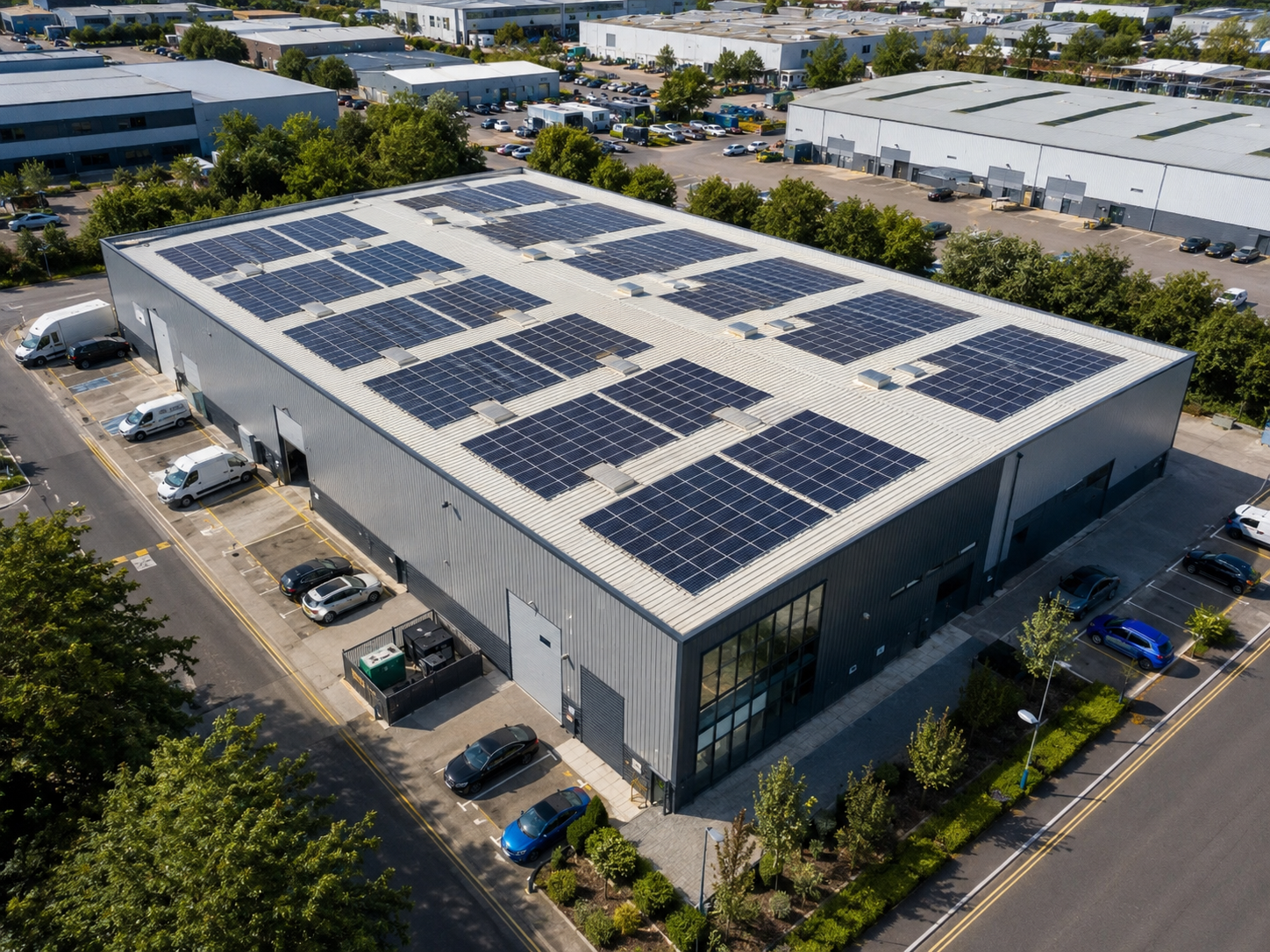
Birmingham still makes things. Metal pressings, plastics, food and parts for the car plants run long weekday shifts under big, mostly steel-clad roofs - exactly the demand profile that lets rooftop solar pay for itself quickly. Here is how a project works in the city, from grid application to payback.
Connecting solar to the Birmingham network
Network operator: National Grid Electricity Distribution (West Midlands)
Birmingham sits in National Grid Electricity Distribution's West Midlands licence area. Most rooftop systems below about 50 kW go through a simple G98/G99 fast-track, while larger factory systems need a full G99 application. Parts of the inner-city network are busy, so we often design for export limitation - consuming nearly all generation on site - which avoids reinforcement costs and keeps the timeline to a few months rather than years.
Expected yield in Birmingham: roughly 950–1,000 kWh per kWp per year - strong UK commercial solar yield, especially on large flat or shallow-pitch roofs.
Industrial estates and business parks we cover in Birmingham
Tyseley and the Tyseley Energy Park
Older engineering works and newer energy-focused units with long, unbroken roof runs.
Aston, Witton and Nechells
Dense manufacturing and metal-finishing sites with heavy daytime motor and compressor loads.
Castle Bromwich and Fort Dunlop area
Automotive supply chain and mixed industrial buildings near the M6.
Hams Hall and Minworth corridor
Large distribution sheds on the eastern edge of the city, often with clear-span roofs above 10,000 m².
Also covering Solihull, Tyseley, Witton, Erdington, Aston, Longbridge, Oldbury, West Bromwich, NEC / Bickenhill · Postcodes B1, B2, B3, B5, B6, B7, B9, B11, B24, B25, B33, B37, B70, B90, B91
Why solar suits Birmingham's key sectors
Automotive and precision engineering
Tier 2 and tier 3 suppliers run CNC machines, presses and compressed air through the working day. Solar generation lines up with that shift pattern, so self-consumption on these sites is commonly 80% or more.
Metal finishing and plating
Plating lines, ovens and extraction are electricity-hungry and difficult to switch off. A rooftop array trims the daytime peak, which is usually the most expensive part of the bill.
Food manufacturing
Bakeries, sauce makers and chilled food producers around the city carry refrigeration loads all day and all year, giving solar a steady place to go even in quieter months.
What a Birmingham project could look like
A 9,000 m² engineering works in Tyseley running two shifts.
- System size
- 350 kWp
- Installed cost
- about £280,000
- Bill saving
- about £60,000 a year
- Payback
- about 4.7 years
Assumes around 975 kWh per kWp, 85% used on site and a 21p/kWh unit rate. Your feasibility review models your own roof, demand and tariff.
Run your own numbersWays to pay for solar in Birmingham
- Funded power purchase agreement (PPA): £0 upfront, you buy the solar electricity at a lower rate than the grid.
- Full Expensing lets limited companies deduct 100% of qualifying solar spend from taxable profit in the year of purchase.
- The West Midlands Combined Authority runs net zero business programmes from time to time; check current eligibility before relying on them.
Schemes change often - always check eligibility before relying on any grant or relief.
Birmingham commercial solar questions
Does Birmingham City Council need to approve rooftop solar on my factory?
Most commercial rooftop solar is permitted development, so no planning application is needed, as long as it stays within size limits and the building is not listed or in a sensitive conservation area. Some Jewellery Quarter buildings are listed or in conservation areas, so check first there.
How long does a grid connection take in Birmingham?
Small systems can be connected within weeks. Larger G99 applications to National Grid Electricity Distribution usually take 8 to 16 weeks for an offer. Export-limited designs tend to get the quickest approvals.
Will my old steel roof take the weight of solar panels?
Many Birmingham works have profiled steel or older asbestos-cement roofs. We commission a structural check on every site. Modern systems add roughly 12 to 15 kg per m², which most steel portal frames handle.
Can I add EV charging for my vans at the same time?
Yes. Pairing solar with workplace chargers lets daytime generation charge fleet vehicles, which is common on Birmingham trade and logistics sites.
Is solar worth it if we only run one shift?
Usually yes. A single 8-to-5 shift still matches most of the solar day. A battery can store any surplus for early-morning start-up.
Other major cities we cover
Birmingham is part of our Midlands service area. See the Midlands guide →
Ready to see whether your roof could reduce your energy bills?
Explore related pages
- Commercial solar in West MidlandsRegional funding, yield and coverage.
- Commercial solar in NottinghamNearby in East Midlands.
- Commercial solar in LeicesterNearby in East Midlands.
- Commercial solar in NorthamptonNearby in East Midlands.
- Solar potential by postcodeSee local solar yield for your business postcode.
- Commercial solar cost guideIndicative UK prices per kWp and what drives them.